















The institution continues expanding its international reach, in a context where the country’s air traffic is increasing and it is becoming an exporter of knowledge
Dominican civil aviation today is measured not only by the number of flights, passengers, or airports in operation. Alongside the growth of air traffic and the pressure this dynamism places on the regulatory system, a less visible but strategically vital dimension for the country’s operational safety has developed: the training of specialized human capital that sustains all aeronautical activity.
In this area, the Higher Academy of Aeronautical Sciences (ASCA) is one of the key components of the institutional framework. This point was highlighted by the Director General of the Dominican Institute of Civil Aviation (IDAC), Igor Rodríguez, in the Special Interview El Caribe–CDN, where he emphasized that strengthening Dominican civil aviation necessarily depends on the continuous training of its technical personnel.
According to his explanation, ASCA plays a decisive role in preparing air traffic controllers, inspectors, navigation technicians, and other specialists who operate in sensitive areas of the aeronautical system. Rodríguez noted that the institution spares no effort or resources in updating knowledge, maintaining ongoing certification, and strengthening the practical experience of its technicians. This approach has been a key factor in the Dominican Republic achieving some of its best operational safety indicators, with no fatalities, even in a context of high volumes of air operations and passenger movement.
In 2024 and 2025, sustained growth in tourism and air connectivity significantly increased the burden on the national aeronautical system. More than 217,000 air operations and nearly 20 million passengers moved in a single year required reinforced standards of oversight, control, and planning. In this scenario, training is not merely a complement but rather a structural matter of public policy in civil aviation.
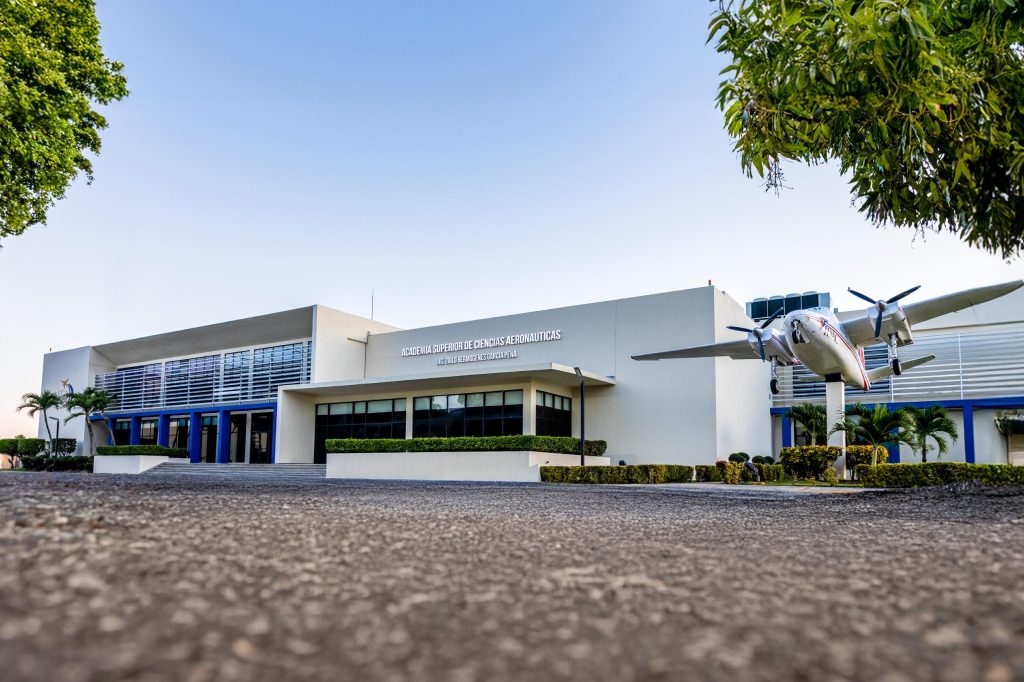
ASCA, attached to IDAC and governed by the Law on Higher Education, Science, and Technology, operates as a specialized higher education center focused exclusively on the aeronautical sector. This is no small matter. Its academic offerings cover areas such as air navigation, operational safety oversight, flight regulations, aeronautical management, and air law, among others. It also incorporates the use of simulators and specialized programs that enable realistic training aligned with international standards.
A Country That Exports Knowledge
Beyond its internal impact, ASCA has steadily expanded its international presence. According to Rodríguez, the academy has become a platform for exporting knowledge by receiving and training technicians and professionals from various countries that lack their own infrastructure, simulators, or aeronautical training centers.
As a result, requests arrive from several States, particularly from Caribbean and South American countries with limitations in aeronautical training. These include Cuba, nations from both the Lesser and Greater Antilles, as well as other countries in the region that have found in ASCA a viable alternative for training their technical personnel.
The IDAC director explained that this process goes beyond passively receiving foreign students. The institution actively promotes the academy in international forums, presenting it as a center with facilities, capabilities, and programs aligned with the demands of modern civil aviation. From these contacts, cooperation agreements are established that allow foreign technicians to train in the country, while Dominican professionals gain access to training experiences in other States.
This exchange has led ASCA and IDAC to establish links with high-level training centers in other regions of the world. Rodríguez cited ongoing efforts with Qatar, Singapore, and the United Arab Emirates as examples. In the case of Dubai, he noted that a Dominican delegation was recently invited by that State, opening the door to a cooperation agreement that will allow IDAC technicians to train at one of the largest aeronautical centers in the world, linked to the airline Emirates.
He also recalled that contacts were made last December with the State of Egypt, a country that has a large-scale aeronautical academy and advanced infrastructure for training pilots, air traffic controllers, and cabin crew. The objective is to formalize agreements that will allow Dominican technicians to gain training experience in those environments, while ASCA shares its training strengths with other countries.
A Regional Benchmark
Rodríguez stated that, for small Caribbean and Central American countries, the Dominican Republic is seen as a benchmark in civil aviation. This perception is based on the stability of the aeronautical system, the operational safety levels achieved, and the existence of an academy that meets international standards.
ASCA has been key in positioning the country as a State capable not only of operating its own airspace with high levels of safety, but also of contributing to regional safety through the training of foreign technicians. This role is particularly relevant in a region where many countries depend on third parties to train their aeronautical personnel.
The economic impact of this model is also significant. The export of knowledge strengthens the Dominican country brand in the aeronautical field and creates networks of technical cooperation that facilitate regional integration.