

















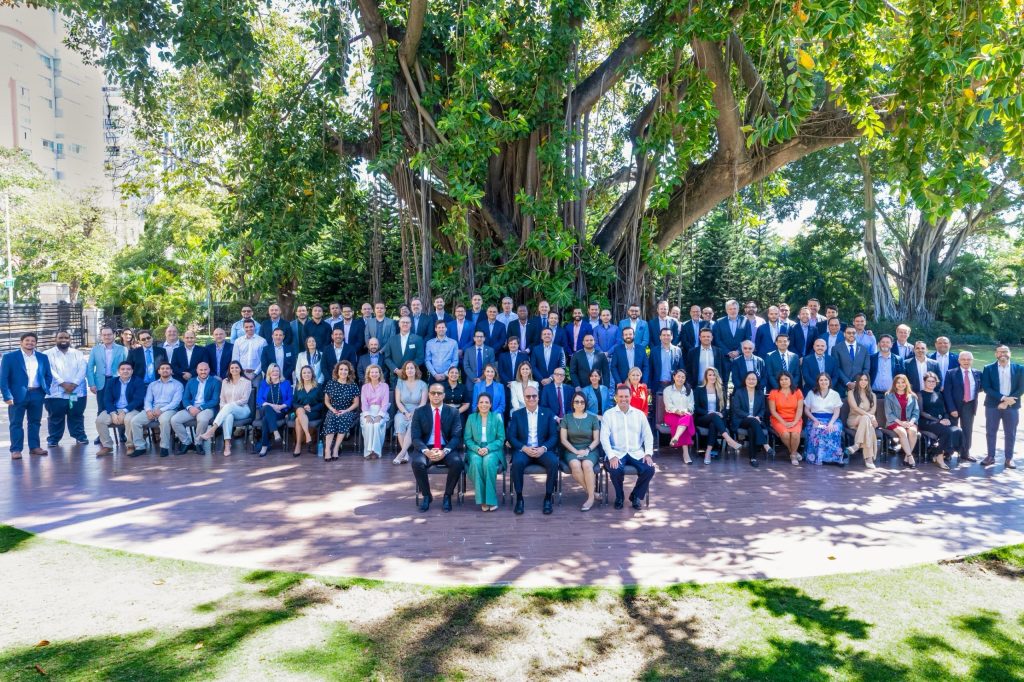
Santo Domingo.- Around 150 representatives from 24 countries are participating in the “Fuel and Sustainability” conference, organized by the Latin American and Caribbean Air Transport Association, Alta, in which they address crucial issues on local and regional initiatives on sustainable aviation fuels.
For five days, national and international missions that ensure an air system free of environmental pollution will discuss interesting topics aimed at finding solutions that will allow us to move towards the future of sustainable aviation.
In this sense, the general director of the Dominican Institute of Civil Aviation, Idac, Igor Rodríguez Durán, in his capacity as host of the international meeting, highlighted the importance of this type of meeting in which States discuss and find solutions to issues that affect the aeronautical industry of the countries involved. “In Dominican Republic, through Idac, we are committed to the preservation of the environment, sustainable development and, of course, aviation safety. Our interest is that, during this day of meetings, we can find solutions that allow us to move towards the future of sustainable aviation,” said Igor Rodríguez Durán.

The head of Idac highlighted the importance of this conference on this meeting, due to the progress and the collective and ambitious global vision it represents, with the aim of reducing Co2 emissions in international aviation through the use of Saf (Sustainable Aviation Fuel) and other sustainable fuels and clean energy. whose goal is to reduce emissions by 5% by 2030, a key commitment for the future of aviation. Likewise, José Ricardo Botelho, who chairs the conference on behalf of Peter Cerdá, Ceo and president of Alta, provided interesting data, such as that between 2011 and 2023, the fuel consumption of Latin American and Caribbean airlines per 100 RPK (Passenger Kilometers Traveled) decreased by 28% thanks to fleet renewal, operational improvements and the adoption of new technologies.
Botelho added that Alta member airlines have reduced the average age of their fleets by 18%, which has allowed them to reap the benefits of state-of-the-art aircraft, which consume between 15% and 20% less fuel. “Latin America and the Caribbean is one of the regions that contributes the least to global Co2 emissions in aviation. In 2023, global emissions from the industry reached approximately 867 million tons, of which only 2.6% corresponded to Brazil and Mexico, the only two countries in the region among the 25 with the highest Co2 emissions from aviation,” he said.

In addition to Botelho and Rodríguez Durán, the opening session of the “Fuel and Sustainability” conference, organized by the Latin American and Caribbean Air Transport Association, Alta, was attended by Paola Aimée Plá Puello, deputy director general of Idac; Miguel Mejía, deputy director-director of Sustainable Development of Idac; Noel Báez, Deputy Minister of Hydrocarbons, representing Joel Santos, Minister of Energy and Mines.
Also attending the meeting were Miguel Solano, representing Mr. Marcos Castillo, Director General of Civil Aviation of Costa Rica; Luis Sánchez, Regional Specialist in Aeronautical Meteorology and Environment of the Icao Regional Office for North America, Central America and the Caribbean; Héctor Porcella, president of the Civil Aviation Board and Max Puig, executive vice president of the National Council for Climate Change and Clean Development Mechanism.
